CRE Chat
Replacing informal messaging with an auditable enterprise communication platform.
ClientC.R. England
RoleLead Product Designer
DurationMulti-phase engagement
Year2024
Replacing informal messaging with an auditable enterprise communication platform.
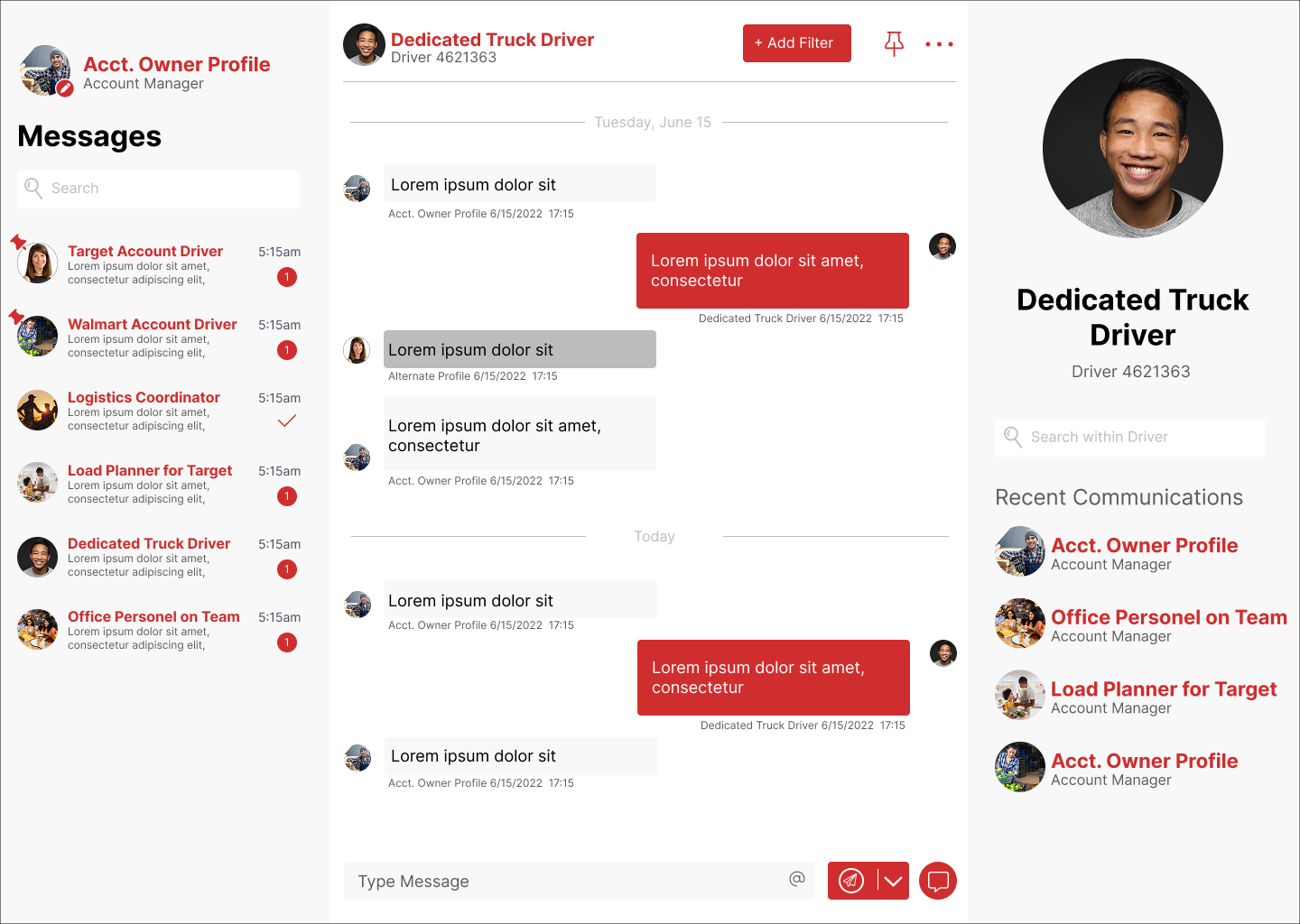
CRE Chat replaced a patchwork of informal communication tools (personal texts, Google Chat, WhatsApp, Qualcomm, email, phone calls) with a single auditable platform for driver coordination. The hard part was never building a chat app. It was designing a system that created accountability without adding friction, in a time-sensitive environment where every extra click has a real cost.
Operations teams at C.R. England coordinated with drivers through a patchwork of unapproved tools: personal text messages, Google Chat, WhatsApp, Qualcomm, email, phone calls, whatever each team found fastest and whatever their drivers happened to have access to. There was no single channel, no shared visibility, no way to know if a message had even been received, let alone acted on.
Time-sensitive decisions during active dispatch had no documented context. Drivers had unequal access depending on personal devices. Escalation paths were unclear. And when issues arose, there was no audit trail to understand what happened or who was responsible.
The lack of traceability made it impossible to improve processes, resolve disputes, or hold anyone accountable. Every team was solving the same communication problem in its own way, and none of those solutions talked to each other.
Defining what was in scope for version one, and just as importantly, writing down what wasn't, turned out to be one of the most important decisions of the project. It gave the team clarity, set stakeholder expectations, and meant we shipped something complete instead of something half-built.
Deferred to deliver a complete, shippable v1 rather than a partial product with two half-built channels.
We made shared visibility the default, with personal filtering as opt-in. Every message to a driver is visible to other office staff unless someone toggles it off, which builds in accountability and cuts down on duplicate outreach.
We put real weight into documentation before design work started (32+ user stories across 5 epics), because in enterprise software, misaligned expectations get paid back in rework, not in a quick iteration.
We deferred MMS and SMS routing to v2 on purpose, rather than ship two half-built channels. The v1 scope was complete and shippable on its own.
We made templates editable by business analysts instead of developers. That removed a permanent engineering dependency and let ops teams own their own workflows.
Delivered an enterprise communication platform that ended the reliance on informal channels and gave the org an auditable record for operational decisions for the first time. Teams got shared visibility with explicit urgency and clear ownership, which let people make faster decisions mid-flow without switching between tools.
The documentation-first approach (interviews, user stories, scope definition, all before design started) meant the development team had clear, unambiguous requirements from day one. Edge cases that would normally surface mid-sprint got resolved before design even began.
These screens represent a selection from a multi-phase engagement designing CRE Chat from scratch — an enterprise communication platform replacing informal channels with an auditable, structured messaging system for office teams and drivers.
01 — Full three-panel layout. A persistent conversation list on the left, the active chat thread in the centre, and the driver profile panel on the right — including recent communications from all office reps. Designed so ops teams never have to leave the tool to access driver context.
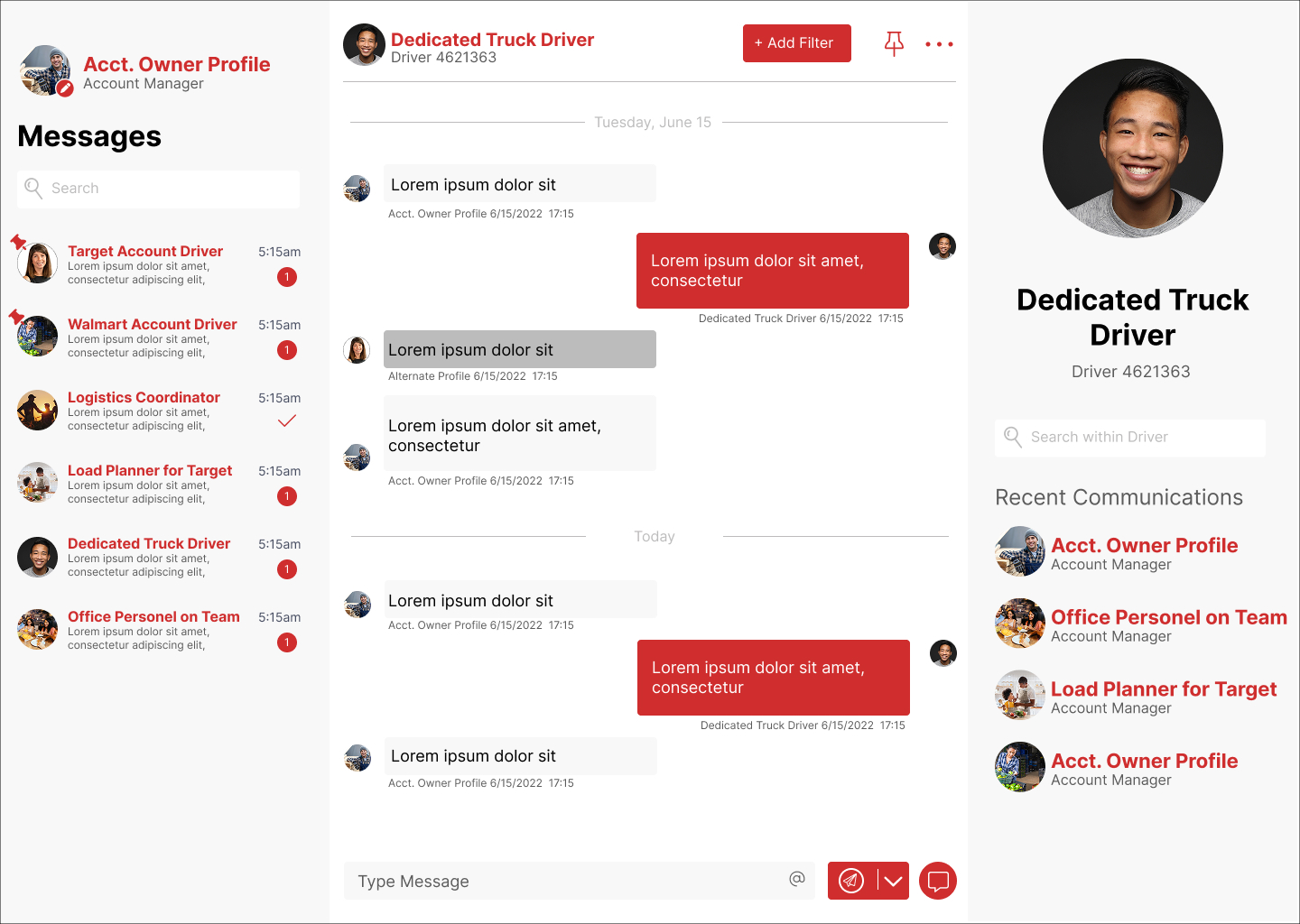
02 — Driver profile panel. Driver photo, name, driver code, and a chronological list of recent communications from all office reps — not just the current user. Built to give ops teams full context before sending a message, reducing duplicate outreach to drivers.
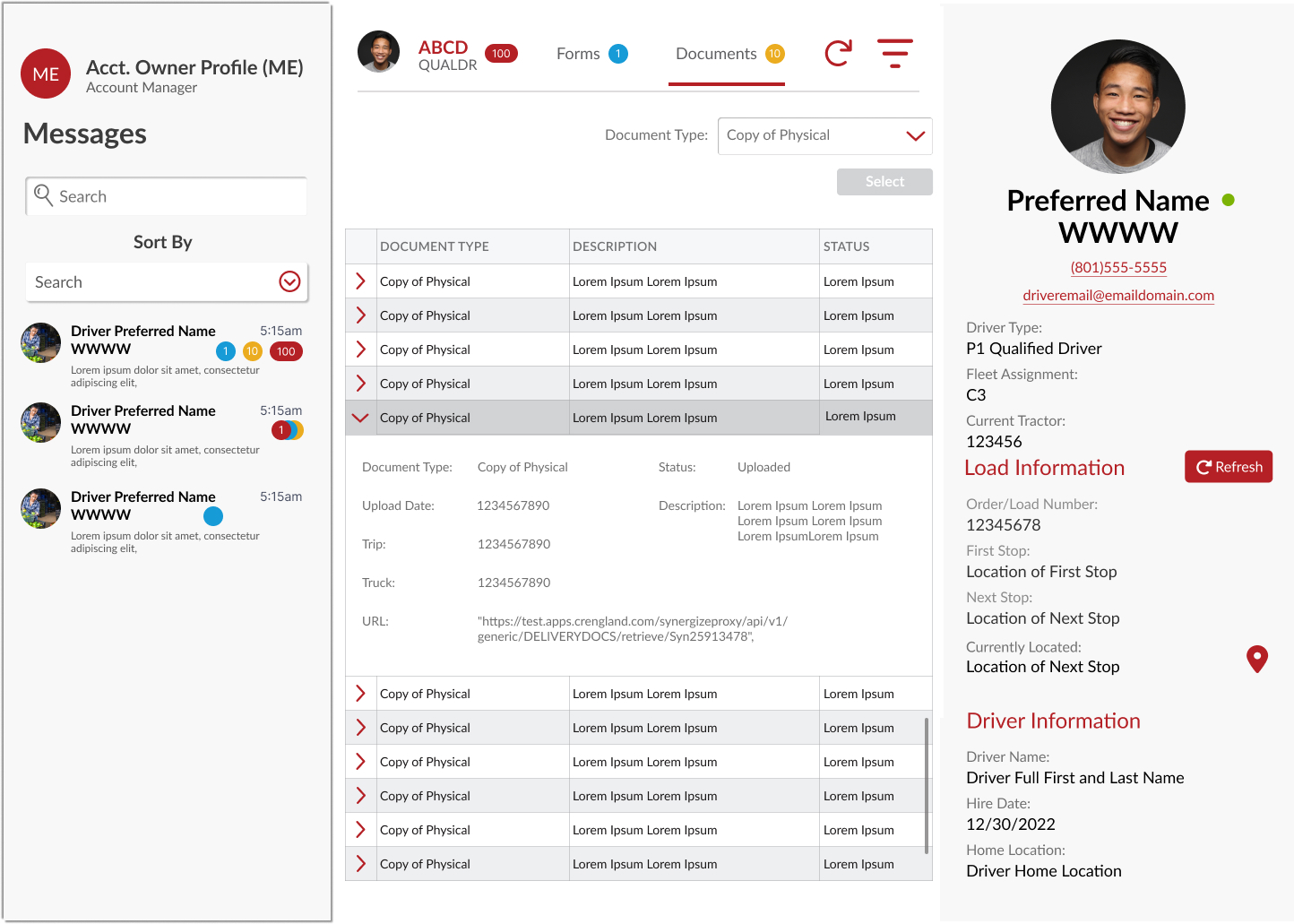
03 — Documents tab. A document management view within the chat — surfacing driver-specific documents by type, status, and description without leaving the messaging context.
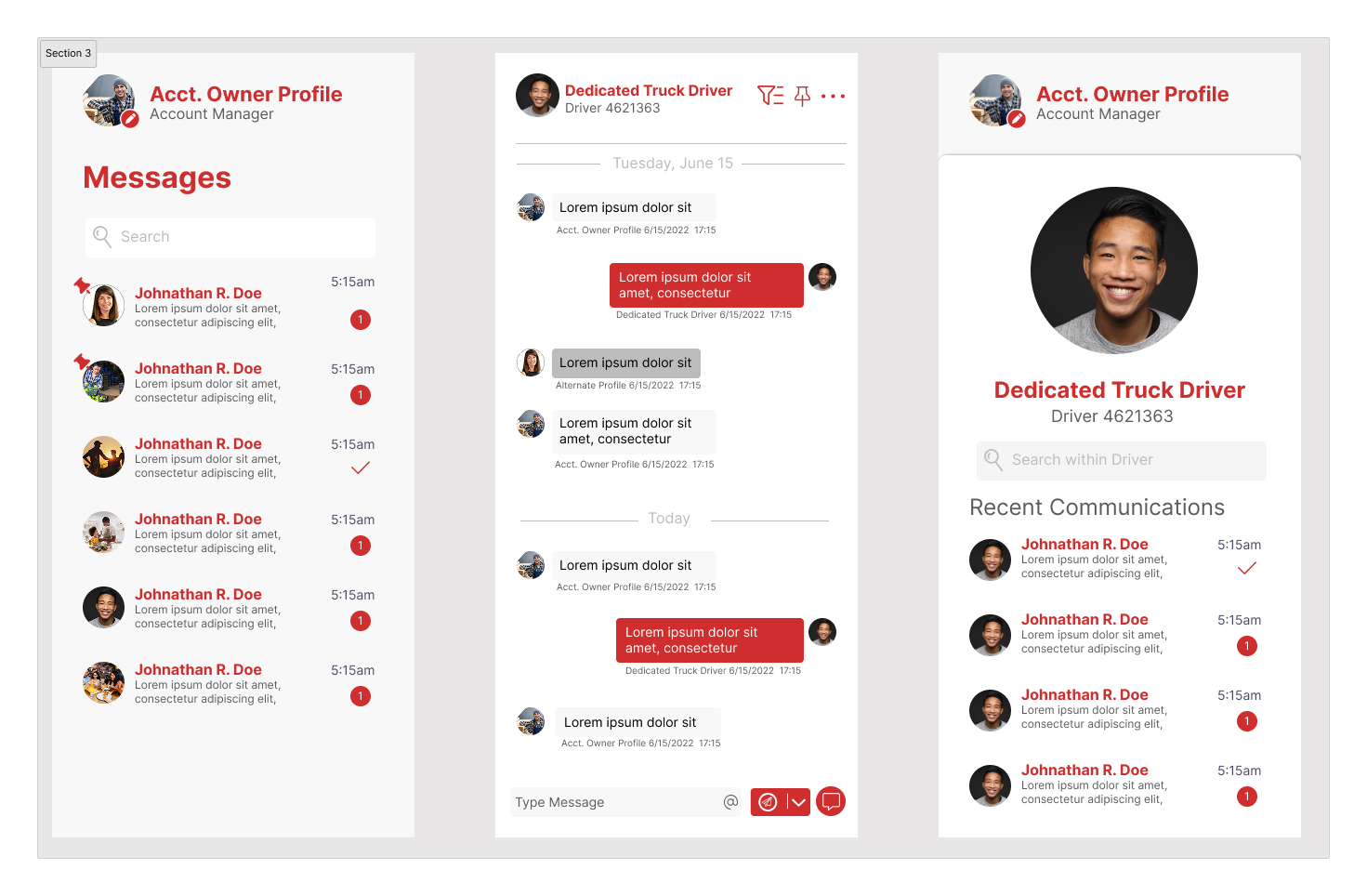
04 — Compact view — resizable layout. The same system in its smallest footprint — designed to sit alongside other tools on screen without taking over. A core requirement from discovery: ops teams needed to use CRE Chat alongside Pega and LiNK simultaneously.
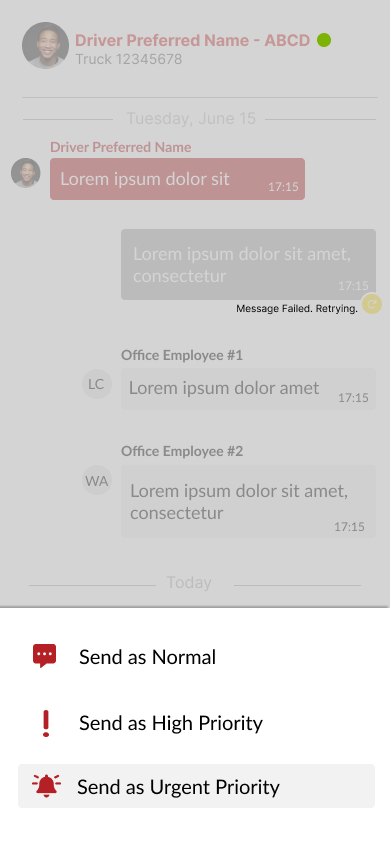
05 — Message priority levels. Three send modes — Normal, High Priority, and Urgent — with distinct visual indicators in the thread. Designed so recipients can triage incoming messages by urgency without opening each one individually.
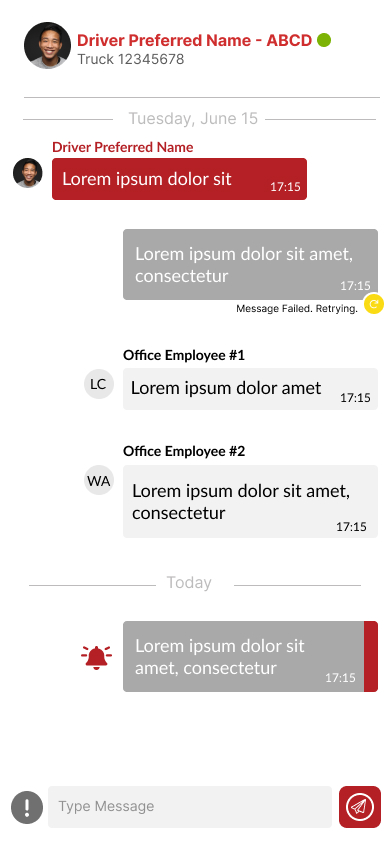
06 — Shared conversation view. All office-to-driver messages visible in one thread, colour-coded by sender. A toggle lets users filter to only their own messages when needed — but shared visibility is the default, creating a complete auditable record of every driver interaction.
What ties these six screens together is that none of them ask the user to think about traceability directly. Sender roles, timestamps, urgency, and shared visibility are all built in by default rather than left to individual discipline. Four different informal tools got replaced by one system, and the audit trail exists because the interface generates it automatically, not because anyone has to remember to create it.